
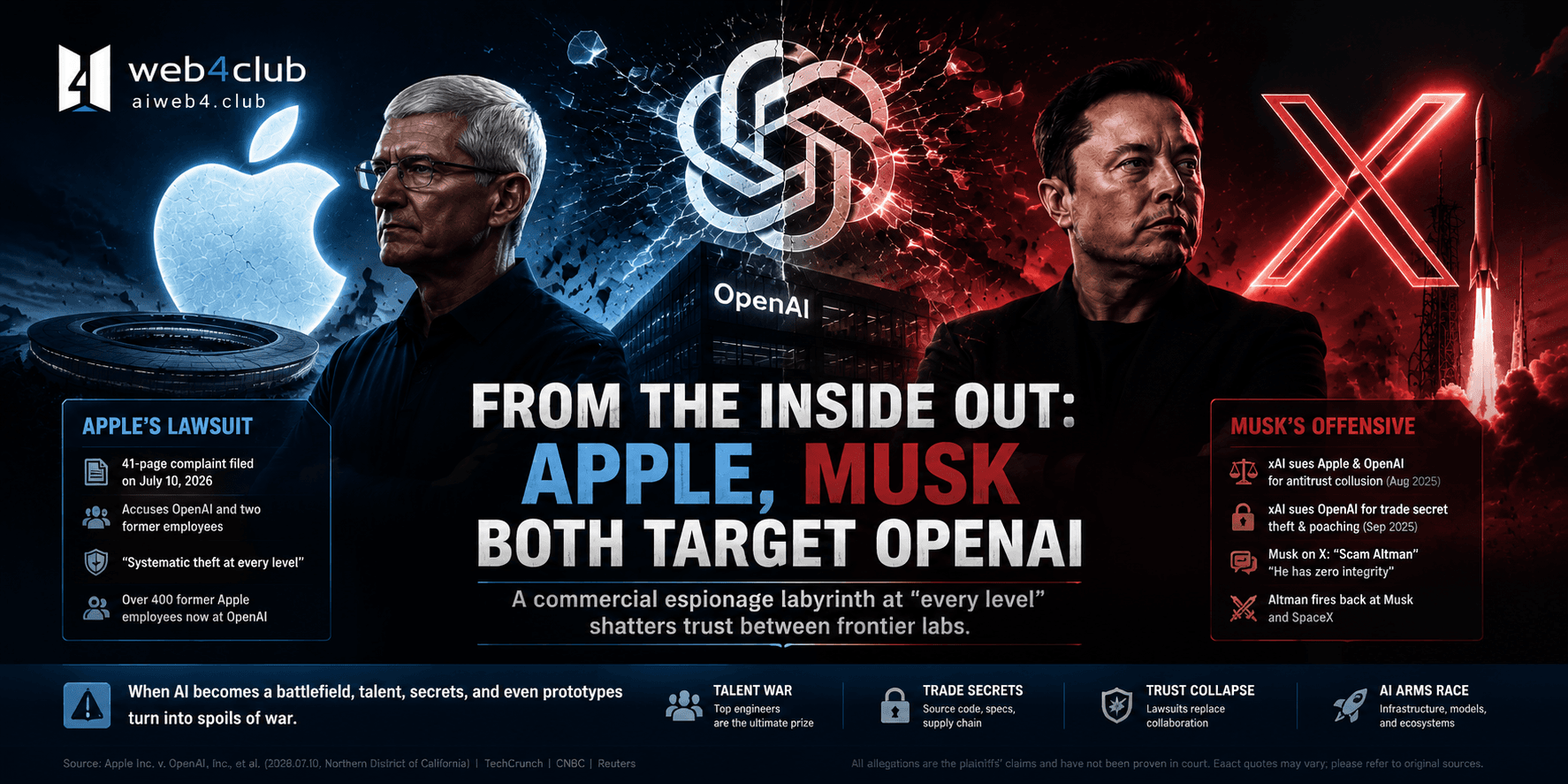
A "multi-layered" trade secret Rashomon splinters trust between leading AI labs
Introduction: On July 10, 2026, Apple filed a roughly 41-page lawsuit in the U.S. District Court for the Northern District of California against OpenAI and two former Apple employees, alleging a systemic theft of trade secrets "at every level." At nearly the same time, Elon Musk’s xAI was launching an offensive against OpenAI on two separate fronts. In an instant, the world's most high-profile AI companies became entangled in a Rashomon-style web of mutual accusations over "theft." This is more than just industry gossip; it rips away the polite facade of the frontier AI race. When intelligence becomes the ultimate strategic battlefield, trade secrets, talent, and even physical prototypes become spoils of war to be fought over in court.
I. A Formal Lawsuit: Apple and OpenAI Completely Break Ties
Let's lay out the facts first. Apple’s lawsuit was filed on July 10 in the U.S. District Court for the Northern District of California. The defendants include OpenAI as a company, alongside two key individuals who defected from Apple. One is OpenAI’s Chief Hardware Officer (a 24-year Apple veteran who previously headed product design for the iPhone and Apple Watch), and the other is a former senior systems electrical engineer at Apple.
The most striking line of the complaint describes the theft as a top-down, systemic operation:
"The theft was not an isolated incident by rogue employees, but rather a coordinated, systemic effort at every level of the organization to misappropriate Apple's most guarded secrets."
Apple also dropped a jarring statistic: there are now over 400 former Apple employees working at OpenAI. This figure itself serves as the perfect footnote to the white-hot AI hardware race—both companies are fighting for the exact same pool of talent on the exact same battlefield.
II. A "Spy Thriller" in the Complaint: Vulnerabilities, Parts, and Exit Tactics
Some details in the lawsuit read like a corporate spy thriller. The former electrical engineer is accused of failing to return his company laptop upon his departure in January 2026. He allegedly exploited an "authentication vulnerability" to "secretly" access Apple’s internal systems even after starting his job at OpenAI, downloading dozens of confidential documents regarding unreleased products and engineering specifications. He even reportedly boasted via text message: "Haha, I found out I can still access [network storage], so funny."
Meanwhile, the Chief Hardware Officer is accused of fishing for Apple product details during interviews with job applicants, requiring candidates to bring "actual parts" for "show-and-tell" presentations. Some candidates were reportedly shocked, noting, "I didn't even know these things could be taken out of the office." The lawsuit further claims that OpenAI circulated an internal Apple document to new hires, coaching them on how to bypass exit procedures that would otherwise result in being "immediately escorted out the door." While these allegations have yet to be adjudicated in court, the dramatic tension is undeniable.
III. "Rotten to its Core": Targeting OpenAI's Hardware Ambitions
Why is Apple reacting so aggressively this time? Because the lawsuit directly targets OpenAI’s aggressive push into AI hardware via its $6.5 billion acquisition of Jony Ive’s hardware company, io—encroaching squarely on Apple's home turf. The lawsuit alleges that io abused Apple’s "secret, proprietary industrial design processes" (involving metal surface finishing and other techniques) and that OpenAI approached suppliers using Apple’s "internal terminology."
This culminated in the most lethal, double-entendre phrasing of the filing:
"OpenAI's hardware initiative is rotten to its core."
The phrase “rotten to its core” is a biting pun, with "core" simultaneously taking aim at Apple's branding and silicon chips. Apple is effectively declaring that OpenAI's entire hardware roadmap is tainted by "original sin" from the very root.
IV. OpenAI’s Response: "We Have Zero Interest in Other Companies' Secrets"
Faced with these heavy accusations, OpenAI’s response rolled out in two stages. Right out of the gate, the company emphasized:
"We have zero interest in other companies' proprietary secrets and have strict policies in place to protect intellectual property."
A few days later (July 14), OpenAI followed up with a formal stance: "While we take these allegations seriously, we do not believe this lawsuit has any merit," while invoking corporate freedom by adding, "We believe in fair competition and that people should have the freedom to choose where they work." In other words, OpenAI is attempting to reframe what Apple calls "systemic theft" into "normal talent mobility"—which remains the core tension of the entire case.
V. Musk Enters the Fray: A Three-Way Rashomon
The plot thickens with a third party. Although Elon Musk is not a party to Apple's specific lawsuit, he wasted no time firing shots across the bow on X (formerly Twitter). Meanwhile, his own company, xAI, is waging its own two-front legal war: an August 2025 lawsuit accusing Apple and OpenAI of an App Store antitrust conspiracy, and a September 2025 lawsuit accusing OpenAI of stealing trade secrets and systemically poaching xAI employees.
As soon as Apple's lawsuit went public, Musk immediately added fuel to the fire, dubbing Sam Altman "Scam Altman" and taunting:
"Turns out they weren't just stealing from xAI, they were vacuuming up Apple's crown jewels too."
Altman hit back by taking potshots at SpaceX. This has created a bizarre spectacle: Apple and xAI are simultaneously accusing OpenAI of "theft" from different directions, transforming the lawsuits themselves into extended weapons of commercial warfare.
VI. Why It Matters: The Collapse of Trust Between Labs
Stepping back to look at the bigger picture, the true significance of this farce is the total collapse of trust between frontier AI laboratories. Consider the ironic contrast: Not long ago on CNBC, OpenAI Chairman Bret Taylor confidently pledged that the company had no interest in others' commercial secrets—yet that very same company is now being sued for "theft of secrets" by both Apple and xAI.
As model capabilities gradually converge, the truly scarce, contestable assets have shifted to talent, source code, supply chains, and even physical prototypes. Silicon Valley's historically tacit "poaching culture" has been dragged into the high-profile spotlight of the courtroom for the first time. Once this trust shatters, industry collaboration and talent mobility will become significantly more expensive and heavily guarded.
VII. Conclusion: A Warning to All Companies
Putting aside who is right or wrong, this case is already being cited by the legal community as a textbook compliance warning for "employees taking former employer data upon departure." It serves as a stark reminder for every tech company to rigorously re-examine their onboarding and offboarding procedures, data access permissions, and non-compete boundaries.
To sum it up: When the AI race intensifies to the point where giants sue over "who stole from whom," it proves that the most scarce resources on this track are no longer just compute power and models—but talent, trust, and the sheer ability to keep a secret.
Source: Apple Lawsuit (July 10, 2026, U.S. District Court for the Northern District of California), TechCrunch, CNBC, Reuters, and other public reports. The allegations contained herein represent the claims of the plaintiffs and have not yet been adjudicated by a court; quotes are translated/compiled and exact phrasing should be verified against the original filings.
Web4Club is a vertical tech media platform dedicated to the convergence of AI and Web3.
← Back to latest