
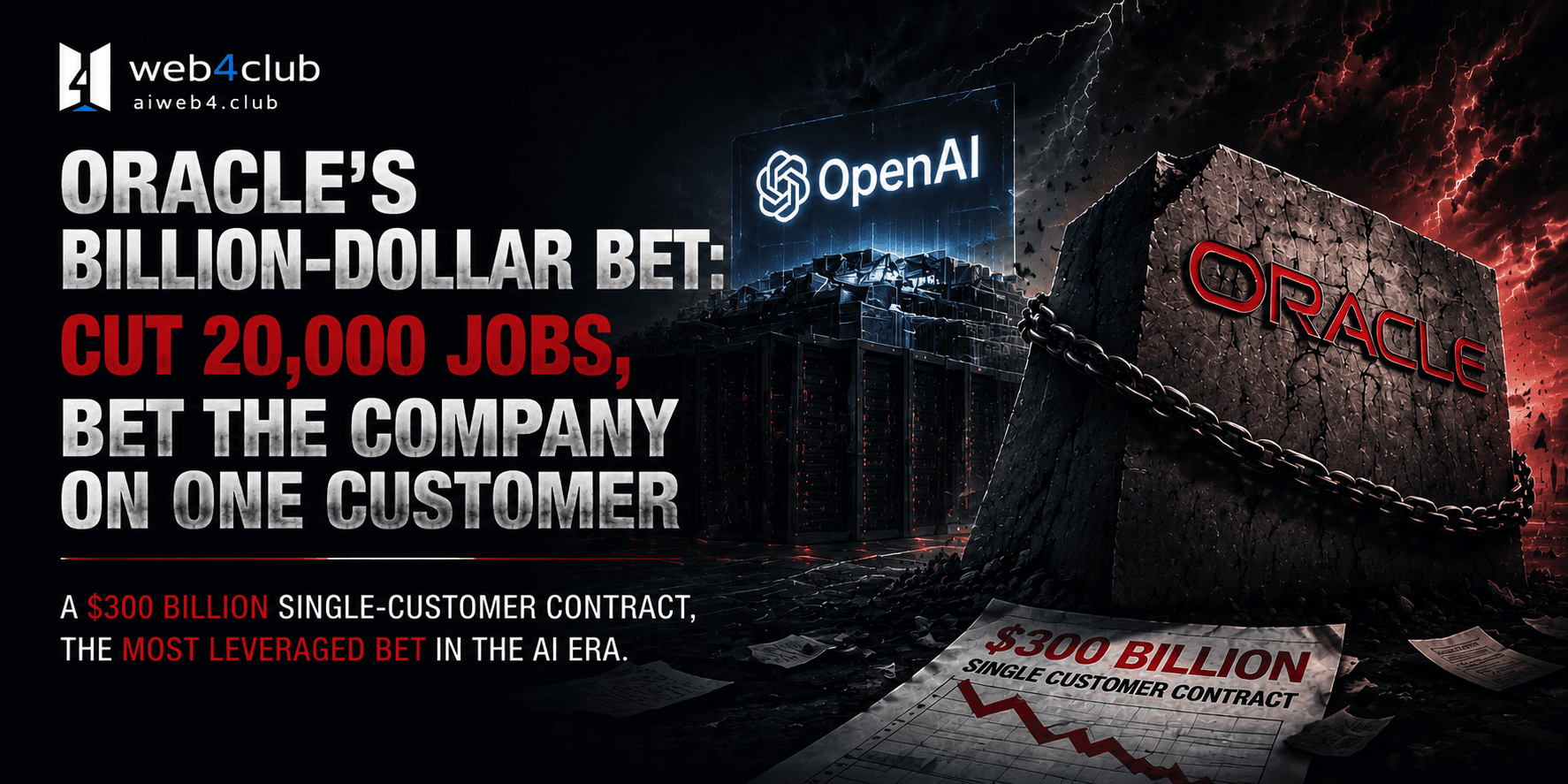
I. A Destiny-Altering Contract
The story begins with a reported 5-year cloud computing contract worth approximately $300 billion. Under the deal, OpenAI is procuring compute capacity from Oracle for its "Stargate" project, involving an estimated 4.5 gigawatts (GW) of new power capacity. It is worth noting that while the $300 billion figure has been widely cited across multiple media outlets, it has not been disclosed line-by-line in official financial reports and should be viewed as a "reported narrative."
Oracle’s excitement over the deal is palpable. Chairman Larry Ellison put it bluntly:
"The demand is unlimited. They want everything we can build, and they want it yesterday."
II. The Cost: 20,000 Laid Off, Hundreds of Billions in Debt
The flip side of this "unlimited demand" is a brutal real-world cost. According to CNBC, Oracle eliminated approximately 21,000 positions over the past year (about 13% of its workforce). When looking at full-year projections, some reports suggest the total layoff scale could reach up to 30,000 workers (roughly 18%). Simultaneously, the company is redirecting an estimated $8 to $10 billion annually from other business units just to construct data centers.
The capital expenditure (CapEx) surge is staggering: climbing from an original plan of roughly $350 billion to around $500 billion, with fiscal year 2027 projections skyrocketing to $900–$950 billion. Consequently, free cash flow is projected to dip into the negative by approximately $42 billion. Simply put, Oracle is taking the money saved from layoffs and combining it with massive amounts of borrowed debt to pour concrete and hoard Nvidia chips. This highlights the most painful paradox of the story: AI is displacing human labor while simultaneously devouring unprecedented amounts of capital.
III. What is Stargate?
Stargate is a massive infrastructure initiative spearheaded by OpenAI, with Oracle and SoftBank serving as primary partners (and Nvidia, among others, acting as a supplier/investor). Announced in January 2025, the project carries a committed investment of up to $500 billion, aiming for a colossal 10 gigawatts of total computing power. Oracle is responsible for roughly 4.5 GW of that total, with data center sites spread across Texas, New Mexico, Wisconsin, and other locations.
OpenAI serves as the "anchor tenant" of this computing empire—its demand justifies the entire construction effort. However, that is precisely where the vulnerability lies: building requires immediate, massive cash outlays to secure land, electricity, and chips, while OpenAI's current revenues remain vastly outpaced by its burn rate.
IV. Lethal Concentration: Half the Empire Tied to One Person
This concentration of revenue is the core of the risk. By mid-2026, OpenAI alone accounted for roughly half of Oracle's $638 billion Remaining Performance Obligations (RPO). In plain terms, half of Oracle's signed future revenue is tied to a single client.
Worse yet, unlike Amazon, Google, or Microsoft, Oracle lacks a massive internal consumer AI ecosystem to absorb or "backstop" this compute capacity if things go sideways. It is using borrowed money to build highly specialized infrastructure for a single client—a client that is still burning cash at an astronomical rate. The risk can be summarized in one sentence:
"If OpenAI stumbles, Oracle is left holding empty mega-warehouses full of rapidly depreciating silicon."
V. Financial Alarms Blare
The market is already voting with its feet. On July 9, 2026, S&P Global Ratings downgraded Oracle’s credit rating to BBB- (just one notch above junk status), explicitly citing OpenAI as a critical credit risk:
"The company's extreme customer concentration and aggressive debt-funded capital expenditures create unprecedented credit vulnerabilities."
In the equity markets, Oracle’s stock price at one point halved from its peak of roughly $345, wiping out approximately $3600 billion in market value, at one stage losing 14% over just six trading days. Interestingly, even as the stock price cratered, the consensus rating among Wall Street analysts remained stubbornly optimistic—a divergence between "analyst buy recs" and "market sell-offs" that underscores just how polarized opinions are.
VI. The Specter of Circular Financing
There is an even more nuanced skepticism brewing: circular financing. Critics have mapped out a closed-loop flow of capital: Nvidia invests in OpenAI → OpenAI pays Oracle for compute → Oracle uses that cash to buy more Nvidia chips. Money flows out of Nvidia as an "investment" and flows back in as "revenue," leading to accusations that the arrangement is "artificially inflating growth figures across all three companies," drawing comparisons to the "vendor financing" schemes of the Dot-Com bubble.
DA Davidson analyst Gil Luria offered a sobering assessment:
"This creates a house of cards scenario. The growth looks spectacular on paper, but the actual cash generation loops back to the exact same closed ecosystem."
VII. Visionary Foresight or Absolute Madness? · Conclusion
Bulls and bears are essentially looking at two sides of the exact same coin. The optimists argue: in the AI era, whoever owns the compute owns the infrastructure of the digital economy; that $638 billion in RPO represents hard, undeniable demand, and Oracle is perfectly positioning itself for the future. The pessimists counter: this is a single-customer, debt-driven gamble with negative cash flows, betting entirely on the assumption that an unprofitable startup will never collapse.
To sum it up: Oracle has staked its corporate survival on the absolute premise that "OpenAI will always be able to pay the rent." If the bet pays off, Oracle becomes the ultimate landlord of the AI age. If it fails, it will be left holding hundreds of billions of dollars worth of concrete and steel, desperately searching for the next tenant.
Source: CNBC, S&P Global Ratings, DA Davidson, BNP Paribas, Data Center Frontier, and other public reports (July 2026). The $300 billion contract value, layoff scale, and annual investments represent reported figures and have not been individually confirmed line-by-line by company officials; quotes are compiled/translated and exact phrasing should be verified against original source materials.
Web4Club is a vertical tech media platform dedicated to the convergence of AI and Web3.
← Back to latest