
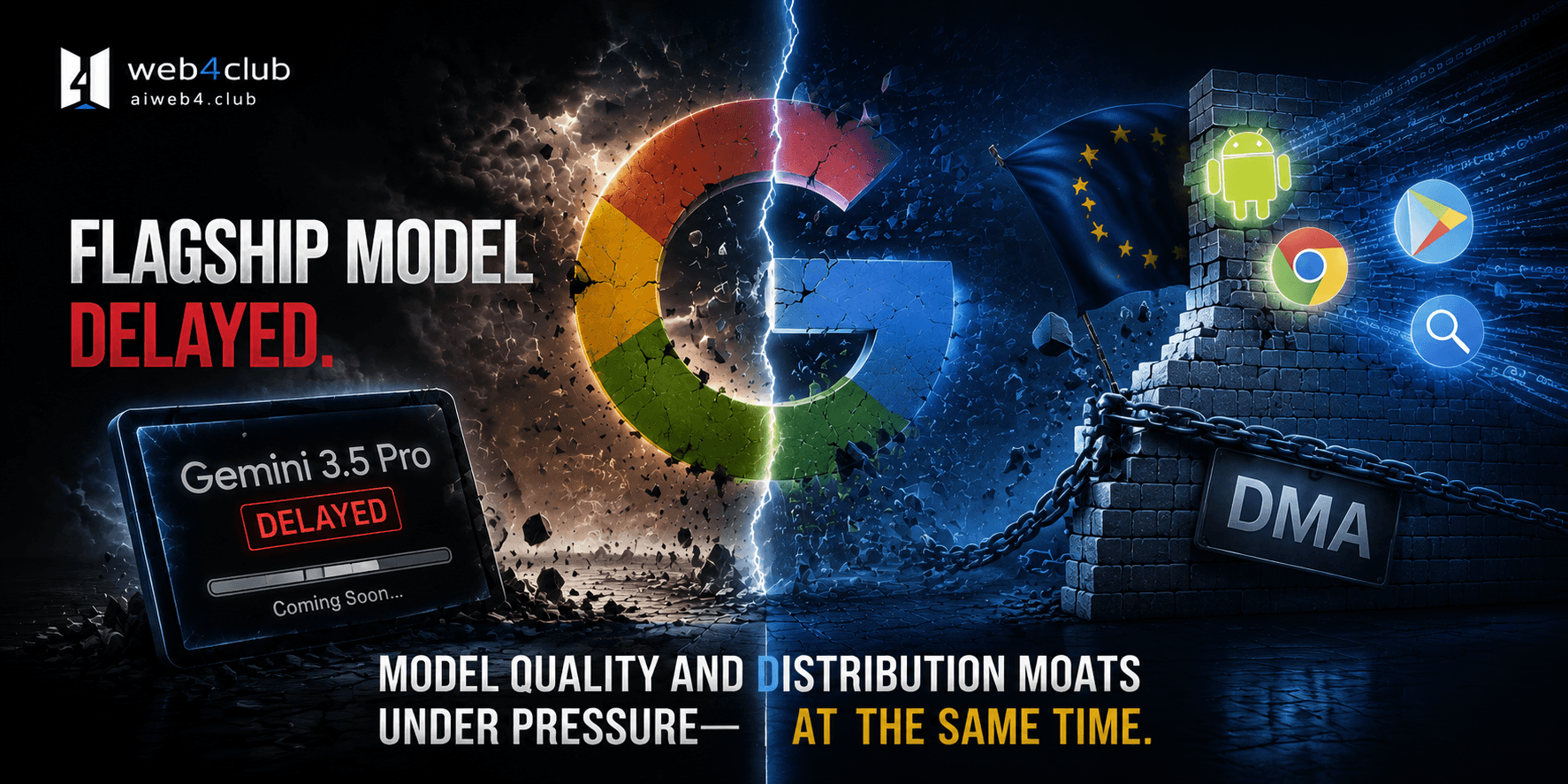
I. Flagship Delay: Gemini 3.5 Pro Falls Months Behind
The trouble began at the flagship tier. At its I/O conference in May, Google promised that Gemini 3.5 Pro would arrive "next month" (June), a deadline that came and went. According to a Bloomberg report on July 16, the model is "months behind schedule." The bottleneck reportedly lies in its coding capabilities—arguably the highest-value frontier capability in 2026. An attempt to bolster coding proficiency by updating the training data reportedly yielded "disappointing results."
To remain objective, the narrative of "three consecutive delays" stems primarily from certain media commentaries; official communications and Bloomberg used the phrase "months behind schedule." Regardless of the exact phrasing, the cadence is rattling market confidence:
"The delay exposes a harsh reality: even with Google's vast resources, scaling up next-generation frontier intelligence is hitting a wall of diminishing returns."
II. The EU Knocks Down Walls: Threatening the Ultimate Distribution Moat
Simultaneously, the European Commission handed down two sweeping mandates under the Digital Markets Act (DMA). First, by July 2027, Google must open 11 core Android features to qualified rival AI assistants (including "Hey Google" style voice activation, cross-app operations, and more). Second, by January 2027, Google must share anonymized search data—including the very data it uses to refine its own search engine—with competing search engines and AI chatbots.
Google strongly opposed the moves. Kent Walker, Google's President of Global Affairs, warned:
"Forcing the fragmentation of Android and the mandatory sharing of proprietary data will not only compromise user privacy and system security but will artificially penalize American innovation to prop up competitors."
The critical factor here is timing. In previous antitrust rounds, there were no viable alternatives to Google Search in the market. Today, Perplexity, ChatGPT, and Claude are active alternatives—and a forced opening could, for the first time, legitimately siphon search queries elsewhere.
III. Internal Rifts: Talent Drain and Market Cap Erasure
Beyond external pressures, Google faces internal friction. Reports surfaced that in late June, four senior Gemini researchers departed for Anthropic. Internally, deep-seated organizational silos (with Search, Maps, YouTube, and Cloud operating as distinct fiefdoms) are blamed for slowing down deployment velocity. The capital markets reacted swiftly: on the day news of the flagship delay broke, Alphabet shares slid roughly 4.4%, erasing approximately $200 billion in market value in a single day.
IV. Google’s Counterattack ①: Flooding the Zone with "Flash" Models
Google is not standing still. On July 21, it launched three models in quick succession: Gemini 3.6 Flash, 3.5 Flash-Lite, and 3.5 Flash Cyber—notably omitting a "Pro" version. These Flash models are cheaper and more token-efficient (with official metrics claiming 3.6 Flash reduces output token usage by about 17% on similar tasks), targeting high-frequency, batch-processed agentic workloads.
This reflects a calculated strategic pivot: while flagship benchmarks capture headlines, the real volume and commercial monetization reside in the affordable, fast, mass-production layer. Winning the high-frequency tier allows them to take their time with the flagship—a move that represents a pragmatic trade-off rather than a retreat.
V. Google’s Counterattack ②: Betting Big on Gemini 4
Alongside the Flash rollouts, Google sent an explicit signal intended to steady market nerves, officially announcing:
"We have already initiated training for our next-generation model, Gemini 4."
By signaling "we are already training a more powerful next-gen architecture," Google hopes to neutralize anxiety surrounding its current flagship delays. Whether this maneuver successfully resets the narrative depends heavily on what Gemini 4 delivers.
VI. The Bull vs. Bear Debate: Is Google Still a Contender?
The bear case is grounded in tangible challenges: the flagship is lagging in crucial coding capabilities, remedial training attempts failed, a full retrain may be required, talent is leaving, internal bureaucracy persists, and aggressive regulatory actions hit all at once—costing the market $200 billion in a day.
Conversely, the bull case remains robust:
- Pervasive Distribution: Android has a global install base of billions, and Google Workspace remains ubiquitous.
- Massive Cloud Infrastructure: Google Cloud platform (GCP) continues to grow at a double-digit clip, serving as an indispensable backbone for enterprise AI.
- Undeniable Financial Strength: Alphabet sits on a mountain of cash, generating massive quarterly profits that can easily sustain a prolonged war of attrition.
Furthermore, Google's in-house TPU pipeline provides long-term cost and supply chain advantages, backed by the deepest research bench in the industry, meaning Gemini 4 retains every opportunity to alter the landscape. Notably, Warren Buffett’s Berkshire Hathaway was even reported to have built a position in the stock. Both sides present compelling evidence, making this a debate over trajectory rather than a definitive conclusion.
VII. Conclusion: The Real Battle Was Never About the "Strongest Model"
Synthesizing both pressures reveals a broader industry truth: as model capabilities converge and rapidly commoditize, possessing the absolute "strongest flagship" is becoming less decisive. Instead, distribution, cost efficiency, ecosystem integration, and regulatory compliance are emerging as the ultimate long-term variables.
To sum it up: while delivering its flagship model on time matters, Google’s ultimate test lies elsewhere. As the "strongest model" ceases to function as an impenetrable moat, the question is whether Google can defend its unparalleled distribution advantage before the regulatory countdown clocks run out.
Source: Google Official Blog, Bloomberg, 9to5Google, European Commission, AI Impact Brief, and other public reports (July 2026). The phrase "three consecutive delays" reflects certain media narratives, while official sources cited "months behind schedule." Certain technical details are from secondary reporting and have not been independently verified. Quotes are compiled/translated and exact phrasing should be verified against original source materials.
Web4Club is a vertical tech media platform dedicated to the convergence of AI and Web3.
← Back to latest